TORII ATLAS · CHOOSE YOUR VISIT
Tokyo Shrines for Love: Which One Fits Your Trip?
Compare Tokyo Daijingu, Hie Shrine and Kanda Myojin by location, relationship traditions and visit scope. Find a shrine that fits your Tokyo plans.
All three shrines have traditions associated with relationship prayers, but they offer different visits. Start with the area you plan to be in, then consider what you want to see alongside your prayers.
This guide compares three selected Tokyo shrines associated with relationship prayers. It is not a ranking of spiritual results or a complete list. Visit-time ranges alone will not distinguish these candidates; their locations, sights and prayer backgrounds matter more.
Start with what matters to you
Tokyo Daijingu
Choose Tokyo Daijingu if you plan to be near Iidabashi and want relationship prayers to be the focus of your visit. Its connection with Ise and Shinto wedding heritage offer context for that tradition.
20–40 min
A short shrine visit, excluding queues and formal prayer services.
Hie Shrine
Choose Hie Shrine if the Akasaka or Nagatacho area fits your day and you also want to see the torii approach to Sanno Inari. The shrine’s relationship tradition has its own background; the torii are a sight to include rather than a measure of that tradition.
20–40 min
A precinct visit, excluding the Treasure Hall, formal prayers and queues.
Kanda Myojin
Choose Kanda Myojin if you plan to be near Akihabara or Ochanomizu and want to see vermilion shrine buildings as well as learn about different prayer traditions. Its three main kami have distinct associations; relationships and business prosperity are not attributed to the same kami.
20–40 min
A precinct visit, excluding formal prayers, museums and queues.
These ranges are planning estimates, not official visit durations. Allow extra time for travel, queues and breaks. Prayer traditions describe cultural associations, not guaranteed results.
Compare the practical details
The buttons below open the named candidates and replace any current comparison. You can then change the selection (up to three).
Chiyoda, Tokyo
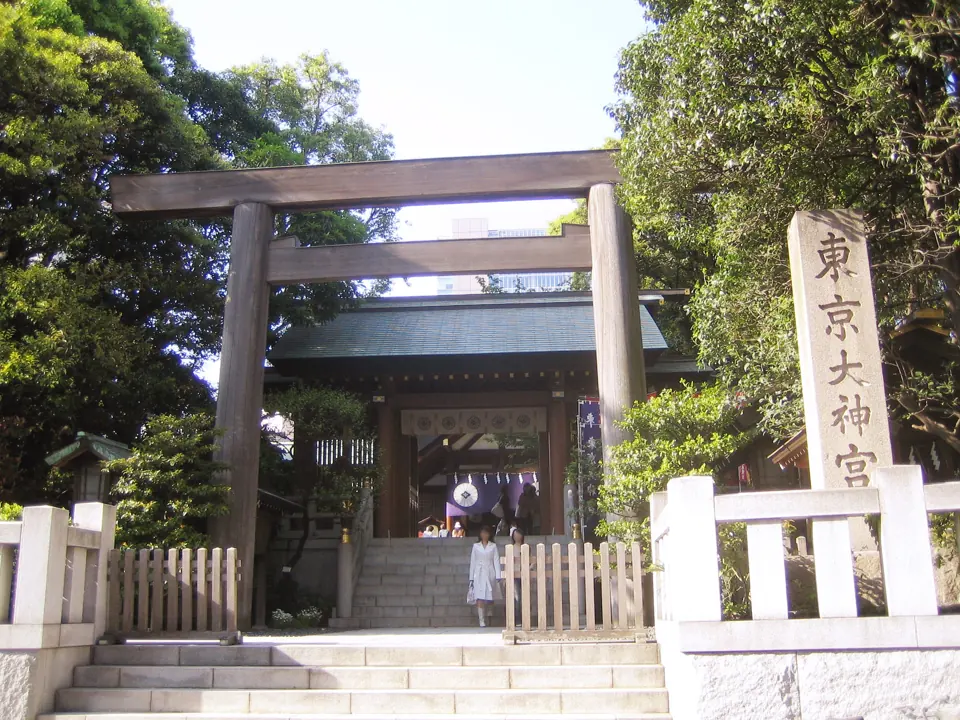
Tokyo Daijingu
東京大神宮
Choose Tokyo Daijingu if you plan to be near Iidabashi and want relationship prayers to be the focus of your visit. Its connection with Ise and Shinto wedding heritage offer context for that tradition.
- What to see
- Prayers for relationships
- Connection with Ise
- Shinto wedding heritage
- Visit time & scope
- 20–40 min
A short shrine visit, excluding queues and formal prayer services.
Allow extra time for crowds and walking at your own pace.
- Getting there
- About 5 minutes on foot from Iidabashi Station. The official routes use JR's west exit, Metro exit B2a (Yurakucho/Namboku lines), or exit A4 (Tozai/Oedo lines). This is the station-to-shrine walk, not total visit time.
- Before you go
- The shrine's relationship tradition is linked to its enshrined kami of creation and growth and its Shinto wedding heritage. This is a cultural association, not a promise of marriage. Goshuin reception ends at 17:00, earlier than the grounds close; allow time before the counter shuts.
Hours, counters & costs
- Grounds hours
- Grounds: 06:00–21:00. Event schedules may change these hours.
- Counter & prayer reception
- Amulets 08:00–19:00; goshuin 09:00–17:00; prayer reception 09:00–16:30.
- Admission & separate costs
- A separate admission fee for an ordinary visit could not be confirmed from official information. Offerings, amulets and formal prayers are separate choices.
Chiyoda, Tokyo
Hie Shrine
日枝神社
Choose Hie Shrine if the Akasaka or Nagatacho area fits your day and you also want to see the torii approach to Sanno Inari. The shrine’s relationship tradition has its own background; the torii are a sight to include rather than a measure of that tradition.
- What to see
- Sanno Inari torii approach
- Hilltop precinct in Nagatacho
- Treasure Hall with a separate visiting schedule
- Visit time & scope
- 20–40 min
A precinct visit, excluding the Treasure Hall, formal prayers and queues.
Allow extra time for crowds and walking at your own pace.
- Getting there
- The official nearest-station list gives about 3 minutes from Akasaka exit 2 or Tameike-sanno exit 7. A separate route description gives about 5 minutes from Tameike-sanno exit 7, so allow extra walking time. These are station-to-shrine estimates, not the visit duration.
- Before you go
- The official relationship-prayer guide links this tradition to Oyamakui and the paired sacred monkey figures in the grounds. These are cultural traditions, not guaranteed results. Amulet and goshuin counters close before the grounds; the Treasure Hall can close for events or exhibition changes.
Hours, counters & costs
- Grounds hours
- Grounds: 06:00–17:00. Check special schedules around New Year and shrine events.
- Counter & prayer reception
- Amulets and goshuin: 08:00–16:00. Formal-prayer reception and Treasure Hall: 09:00–16:00.
- Admission & separate costs
- The Treasure Hall is free according to the official guide; event or exhibition closures may apply. An ordinary-visit admission fee is not stated in the pages reviewed. Offerings and formal prayers are separate.
Chiyoda, Tokyo
Kanda Myojin
神田明神
Choose Kanda Myojin if you plan to be near Akihabara or Ochanomizu and want to see vermilion shrine buildings as well as learn about different prayer traditions. Its three main kami have distinct associations; relationships and business prosperity are not attributed to the same kami.
- What to see
- Vermilion shrine buildings
- Three kami with distinct prayer traditions
- Kanda Matsuri heritage
- Visit time & scope
- 20–40 min
A precinct visit, excluding formal prayers, museums and queues.
Allow extra time for crowds and walking at your own pace.
- Getting there
- About 5 minutes on foot from JR Ochanomizu's Hijiribashi exit, or 7 minutes from JR Akihabara's Electric Town exit. These official estimates are the station-to-shrine walk, not the time spent visiting.
- Before you go
- The official deity guide associates Onamuchi (also called Okuninushi) with relationships, Sukunahikona with business prosperity, and Taira no Masakado with protection. These are worship traditions, not guaranteed outcomes. Counter hours are not grounds hours; recheck the dated amulet notice for visits after December 2026 and confirm goshuin reception separately.
Hours, counters & costs
- Grounds hours
- Regular grounds opening and closing times could not be confirmed from the official pages reviewed. Check with the shrine before an early or late visit.
Dated hours or seasonal information needs a fresh check. Confirm the latest official notice before visiting. Official site
- Counter & prayer reception
- Amulet counter: 09:00–18:00 through 31 December 2026, according to the current notice. New Year hours differ. Regular goshuin and formal-prayer reception hours remain unconfirmed.
- Admission & separate costs
- Ordinary-visit admission: not confirmed in the official information reviewed. Offerings, amulets and formal prayers are separate.
Before you decide
Choose the visit area first, then check opening hours and any counter you need. A shrine’s grounds may stay open after amulet or goshuin reception ends. Check dated announcements for seasonal visits, and use the official website for last-minute changes.
First shrine visit: steps, etiquette and offerings →Sources & information dates
Selection advice is Torii Atlas’s interpretation of the listed facts, not a personal visit report. Practical details come from the same records as the shrine guides; the dates below are their last checks, not a new source review for this article.